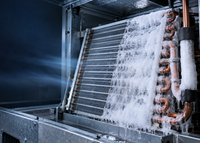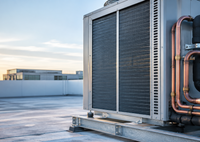
Ice on an air conditioner may look like a sign of powerful cooling, but it usually means the system is no longer transferring heat correctly. As ice builds across the evaporator coil, airflow decreases, cooling performance drops, and the system may run longer without reaching the desired indoor temperature.
A frozen evaporator coil is a symptom rather than a complete diagnosis. Restricted airflow is a common cause, but refrigerant problems, unsuitable operating conditions and control failures can produce similar results. Finding the real cause requires looking at the HVAC system as a whole.
How the Evaporator Coil Works
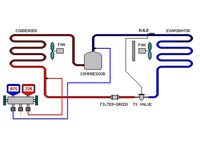
The evaporator coil is the indoor heat exchanger in a typical air-conditioning system. During cooling, low-pressure refrigerant enters the coil at a temperature below the indoor air. The blower moves warm return air across the coil, allowing the refrigerant to absorb heat and evaporate. The cooled air is then distributed back into the building.
The coil also removes moisture from the air. When warm, humid air contacts its cold surface, water vapour condenses into liquid and drains away through the condensate system.
Under normal conditions, the coil is cold enough to collect condensation but not cold enough to freeze it. If airflow or refrigerant conditions cause the coil temperature to remain below the freezing point of water, that condensation can turn into ice.
Once ice begins to form, it blocks airflow between the coil fins and reduces heat transfer. This creates a continuing cycle:
Lower coil temperature → ice formation → reduced airflow → weaker heat transfer → more ice
Eventually, the air conditioner may produce very little cool air even though the compressor continues to operate.
The Main Causes of a Frozen Evaporator Coil
Restricted airflow is one of the most common causes. The evaporator needs a continuous supply of warm indoor air to maintain normal heat transfer. If too little air passes across it, the refrigerant cannot absorb enough heat and the coil temperature may fall below freezing.
Airflow can be reduced by:
● A dirty or clogged air filter;
● Blocked return or supply vents;
● A dirty evaporator coil;
● Restricted or damaged ductwork;
● An incorrect blower-speed setting;
● A failed blower motor or control component.
Refrigerant-side problems can cause similar symptoms. A refrigerant leak may reduce the system charge, lowering evaporator pressure and saturation temperature under certain operating conditions. A restricted metering device, filter-drier or refrigerant line may also starve part of the evaporator and create abnormal coil temperatures.
However, visible ice does not prove that the system is low on refrigerant. Adding refrigerant without confirming the cause can result in an incorrect charge and may hide an airflow, control or restriction problem.
Operating conditions also matter. Running cooling mode when the outdoor temperature is below the equipment’s approved range, operating with an unusually low indoor load or setting the thermostat excessively low may contribute to coil freezing. Equipment sizing, sensor location and capacity-control problems can also affect system behaviour.
The Main Causes of a Frozen Evaporator Coil
Restricted airflow is one of the most common causes. The evaporator needs a continuous supply of warm indoor air to maintain normal heat transfer. If too little air passes across it, the refrigerant cannot absorb enough heat, and the coil temperature may fall below freezing.
Airflow can be reduced by:
● A dirty or clogged air filter;
● Blocked return or supply vents;
● A dirty evaporator coil;
● Restricted or damaged ductwork;
● An incorrect blower-speed setting;
● A failed blower motor or control component.
Refrigerant-side problems can cause similar symptoms. A refrigerant leak may reduce the system charge, lowering evaporator pressure and saturation temperature under certain operating conditions. A restricted metering device, filter-drier or refrigerant line may also starve part of the evaporator and create abnormal coil temperatures.
However, visible ice does not prove that the system is low on refrigerant. Adding refrigerant without confirming the cause can result in an incorrect charge and may hide an airflow, control or restriction problem.
Operating conditions also matter. Running cooling mode when the outdoor temperature is below the equipment’s approved range, operating with an unusually low indoor load or setting the thermostat excessively low may contribute to coil freezing. Equipment sizing, sensor location and capacity-control problems can also affect system behaviour.
The Main Causes of a Frozen Evaporator Coil
Restricted airflow is one of the most common causes. The evaporator needs a continuous supply of warm indoor air to maintain normal heat transfer. If too little air passes across it, the refrigerant cannot absorb enough heat, and the coil temperature may fall below freezing.
Airflow can be reduced by:
● A dirty or clogged air filter;
● Blocked return or supply vents;
● A dirty evaporator coil;
● Restricted or damaged ductwork;
● An incorrect blower-speed setting;
● A failed blower motor or control component.
Refrigerant-side problems can cause similar symptoms. A refrigerant leak may reduce the system charge, lowering evaporator pressure and saturation temperature under certain operating conditions. A restricted metering device, filter-drier or refrigerant line may also starve part of the evaporator and create abnormal coil temperatures.
However, visible ice does not prove that the system is low on refrigerant. Adding refrigerant without confirming the cause can result in an incorrect charge and may hide an airflow, control or restriction problem.
Operating conditions also matter. Running cooling mode when the outdoor temperature is below the equipment’s approved range, operating with an unusually low indoor load or setting the thermostat excessively low may contribute to coil freezing. Equipment sizing, sensor location and capacity-control problems can also affect system behavior.