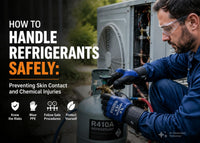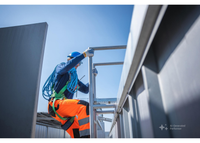
In the HVAC industry, working at heights is an everyday reality—whether installing residential split systems or servicing heavy commercial Rooftop Units (RTUs). Relying on vague advice like "be careful" is not enough. True jobsite safety requires a strict understanding of physical laws, rigid field protocols, and the correct implementation of proper gear.
This guide provides an actionable blueprint for safely navigating high-altitude HVAC work, focusing on extension ladder geometry, proper climbing ergonomics, and common commercial and residential rooftop hazards.
The Physics of Ladder Setup: The 4:1 Rule
A ladder is a dynamic mechanical system subject to the laws of friction, gravity, and structural stress. Improper placement is the root cause of most slide-outs and tipping incidents. To ensure structural stability, technicians must strictly implement the 4:1 Rule (the internationally recognised 75.5-degree safe angle rule).
Why the 4:1 Ratio is Critical
● Too Steep (e.g., 5:1 or 6:1): The technician's centre of gravity shifts dangerously backward during ascent. A slight shift in balance or a sudden gust of wind can cause the ladder to tip over backwards away from the wall.
● Too Shallow (e.g., 3:1 or 2:1): The downward weight of the technician shifts into an extreme outward horizontal force at the base. This drastically increases the probability of the ladder feet sliding out on slick surfaces like wet concrete, grass, or asphalt.
Standard Ladder Deployment Protocol
● Verify the Foundation: Ensure the ground surface is level and completely free of frozen mud, loose gravel, oil stains, or uneven pallets. On soft soil, flip the ladder’s safety shoes down so the steel spurs dig firmly into the ground.
● Clear Overhead Hazards: Scan the area before raising the rails. Maintain a minimum 10-foot clearance from all overhead power lines, low-hanging branches, or building projections. Remember that wet or dirty fibreglass can still conduct deadly current.
● The 3-Foot Extension Rule: When accessing a roof, the top of the ladder rails must extend at least 3 feet (or 3 rungs) past the absolute edge of the roof deck or parapet. This extension provides a critical structural handhold when transitioning between the ladder and the roof surface.
● Secure the Structure: Once positioned, tie off the top rungs to the building facade, structural steel, or gutter line using heavy-duty ratchet straps. If no tie-off point exists, a second technician must firmly "foot" the base until the top can be anchored.
Climbing Techniques: The 3-Point Contact Rule
The act of climbing introduces dynamic forces that must be strictly controlled. Technicians must maintain the 3-Point Contact Rule during every second of ascent and descent.
Your body must maintain one of two structural configurations on the ladder rungs:
● Two hands and one foot firmly planted.
● One hand and two feet securely positioned.
Hands must grip the horizontal ladder rungs directly—not the vertical side rails—as rungs offer superior mechanical grip if a foot slips.
Logistics and Tool Transportation
Hand-carrying diagnostic equipment, recovery cylinders, or parts while climbing is a direct violation of safety standards. It compromises balance and leaves the technician with only two points of contact.
● The Backpack Method: Pack all necessary hand tools and digital testing instruments into an HVAC-specific heavy-duty tool backpack. This distributes the weight evenly across both shoulders, keeps your centre of gravity tight against the rungs, and leaves both hands free to climb.
● The Haul Line System: For heavy gear such as vacuum pumps, recovery machines, and refrigerant tanks, climb the ladder empty-handed. Once securely on the roof, use a high-tensile utility rope equipped with a locking carabiner or compact pulley to hoist the equipment safely from the ground. Transitioning to lighter, modern digital tools can further reduce physical fatigue and climbing risks.
Navigating Flat and Commercial Rooftop Hazards
Stepping off the ladder onto a flat roof introduces a new set of hidden architectural and environmental hazards. Commercial roofs require intense situational awareness.
Skylights and Roof Hatches
Skylights are among the most deceptive hazards on commercial properties. Due to years of UV exposure, older plastic or fibreglass skylight covers become incredibly brittle. They are absolutely not designed to support human weight, and stepping on one can cause an immediate fall through the roof into the facility below.
● The Protocol: Treat every skylight as an open hole in the floor. Never walk near them, sit on them, or place heavy tool bags on their surfaces. Maintain a minimum 6-foot safety perimeter away from all skylight structures.
Roof Membranes and Edge Awareness
Commercial single-ply thermoplastic membranes (such as TPO or EPDMs) provide reasonable traction when dry. However, they become as slick as ice when subjected to early morning dew, frost, sudden rain, or grease blow-by from commercial kitchen exhaust hoods.
● The Protocol: Maintain absolute edge awareness. If an RTU is located within 6 feet of an unprotected roof edge, standards require a permanent or temporary guardrail system, or the technician must wear a full-body harness tied into a certified anchor point via a fall-arrest lanyard. Work near unprotected edges must be aborted if wind speeds exceed 25 mph.

Structural Inspections and the Residential Challenge
Residential HVAC service presents unique difficulties, often requiring technicians to navigate high-pitch roofs without any industrial guardrails or engineered anchor points.
Identifying Structural Decay
Before stepping onto a residential roof to service a split-system heat pump or an exhaust cap, look for signs of deck rot from the ground or from the top of the ladder.
● Inspect the structure for sagging roof lines, water-stained fascia boards, missing shingles, or soft spots in the plywood decking.
● If a roof shows signs of water damage or wood rot, do not walk on it. The weight of a fully geared technician can cause a sudden structural collapse. In these scenarios, use alternative access methods, such as a specialised boom lift, or insist that the homeowner have the structural decking repaired before the HVAC system is serviced.
Managing Roof Pitch and Proper Footwear
The steepness of a residential roof is measured by its pitch (e.g., a 6/12 pitch means the roof rises 6 inches vertically for every 12 inches of horizontal run). Any roof with a pitch greater than 4/12 requires enhanced caution.
● Always wear professional-grade, slip-resistant work boots with heavy rubber outsoles designed to grip asphalt granules or metal seams. Clean your boot soles of mud, grease, or wet grass before stepping onto the roof.
● Walk along the roof ridges and structural valleys whenever possible, as these areas provide the highest structural support and stability.
Conclusion: A Culture of Zero Compromise
Workplace safety in the HVAC industry is driven by an individual mindset. It is easy to fall into the trap of complacency—assuming that a quick two-minute repair does not require a tie-off or a safety harness. However, an unexpected gust of wind or an unnoticed patch of morning frost takes only a fraction of a second to cause a life-altering accident.
The true mark of an elite HVAC technician is the ability to combine top-tier technical expertise with a zero-compromise approach to safety. Please commit the "4:1" ladder setup rule to memory and master the "3-point contact" method to minimise your exposure to dangerous heights. Invest the extra few minutes to secure your equipment and analyse your surroundings. Work smarter, work safer, and make sure you step off that final ladder rung safely at the end of every shift.